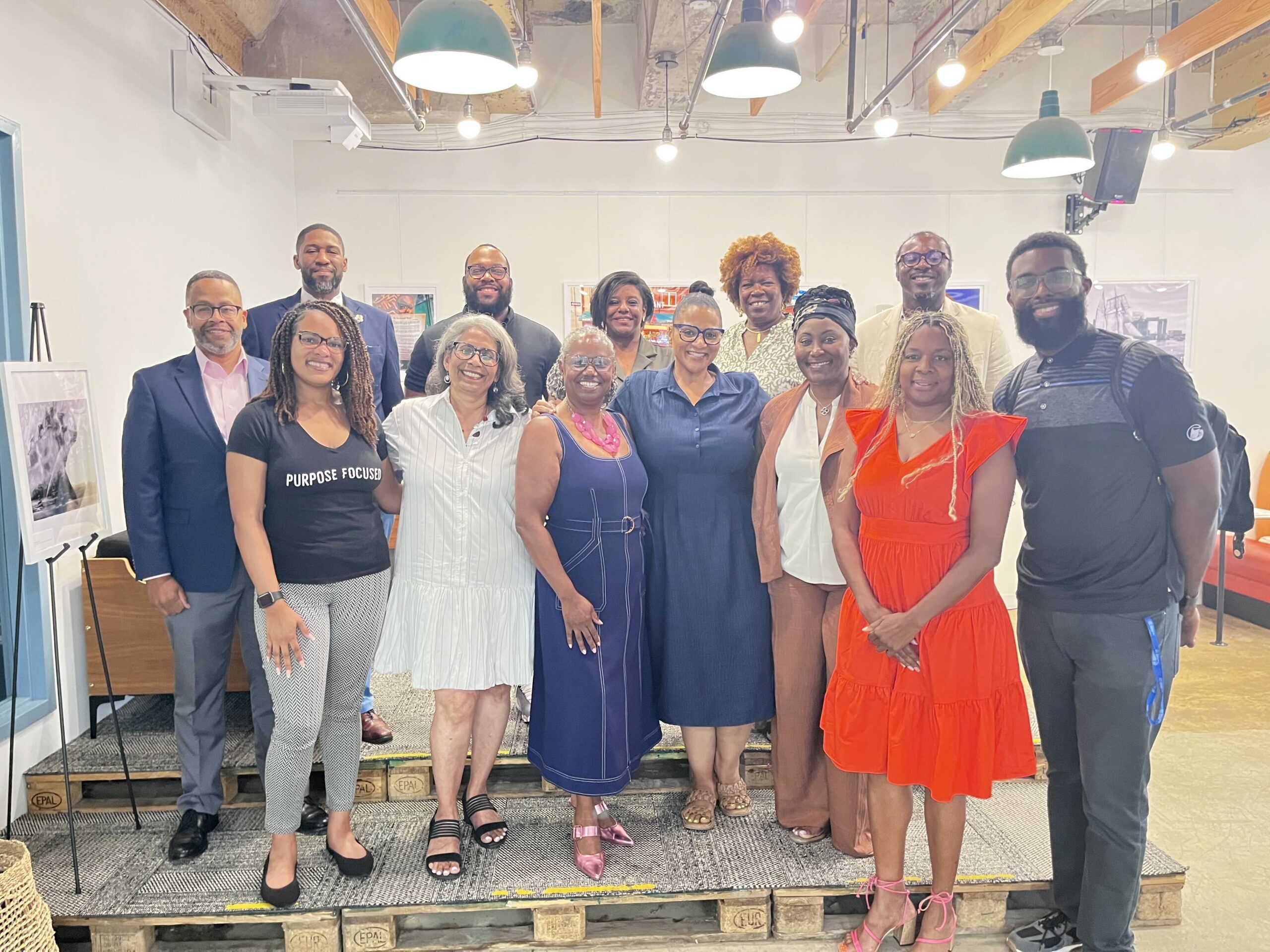
This article was written by FUSE Executive Fellow Lolita Jackmon
When we talk about access to capital for small businesses, the conversation often starts with money: loans, grants, credit, and investment. During my FUSE Executive Fellowship with Baltimore City’s Mayor’s Office of Small & Minority Business Advocacy & Development (SMBA&D), I learned that capital readiness extends far beyond financial readiness and that the broader ecosystem of support businesses need to successfully access and deploy capital is too often overlooked.
Baltimore already has a robust ecosystem of financial institutions, technical assistance providers, economic development organizations, universities, accelerators, and community partners. The opportunity is to make that ecosystem easier for business owners to navigate by helping them answer a fundamental question: What does my business need now, in what sequence, and who is best positioned to help me get there?
A mentor once told me something I have never forgotten: “Diagnosis without examination is malpractice.”
That principle applies well beyond medicine. In economic development, the strongest solutions begin by examining the business before determining whether the right intervention is financing, technical assistance, a strategic relationship, stronger operating systems, or some combination of these.
That thinking led to the development of the 4 Pillars of Capital, a business-readiness framework centered on four interconnected areas: Human, Social, Structural, and Financial Capital.
Human Capital considers leadership, talent, skills, and execution capacity. Social Capital examines customers, advisors, partnerships, and networks. Structural Capital addresses operating systems, technology, governance, and business infrastructure. Financial Capital focuses on financial management, cash flow, credit, and funding readiness. The premise is simple: before prescribing capital, understand what the business actually needs.
The framework also makes the concept of business capital more accessible to broader audiences by connecting it to familiar elements of business: people, relationships, systems, and money. It gives business owners, resource providers, and policymakers a shared vocabulary for discussing business needs in plain language.
Moving from discovery to a testable model
My Fellowship started with a Listening Tour.
Through engagement with entrepreneurs, financial institutions, business-support organizations, City leaders, and economic-development partners, a consistent theme emerged: Baltimore has significant resources, and there is an opportunity to strengthen coordination, navigation, and alignment around each business’s actual readiness and priorities.
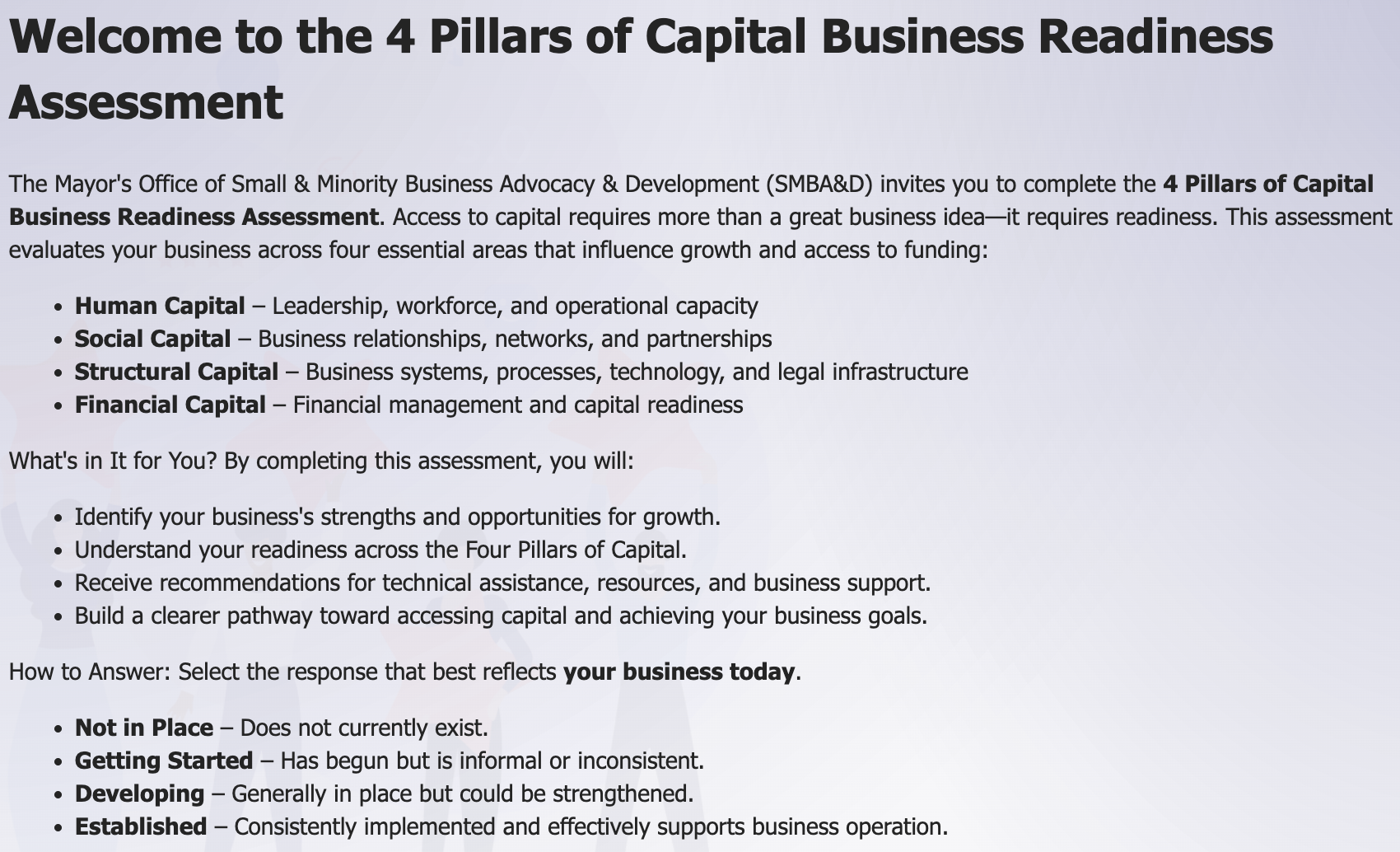
Subsequently, I translated those findings into a 60-question readiness assessment designed to help business owners evaluate their organizations across the four pillars. The assessment generated individualized profiles intended to surface strengths, potential constraints, and areas where targeted support could accelerate growth.
The next step was to see how the framework performed in practice.
That became the purpose of the Innovation Lab.
We wanted to test how accurately the assessment reflected business owners’ lived realities, how subject-matter experts interpreted the same information, and how Baltimore’s existing ecosystem could translate those findings into coordinated, actionable pathways.
In many ways, the Innovation Lab became our examination room.
Putting the business owner at the center
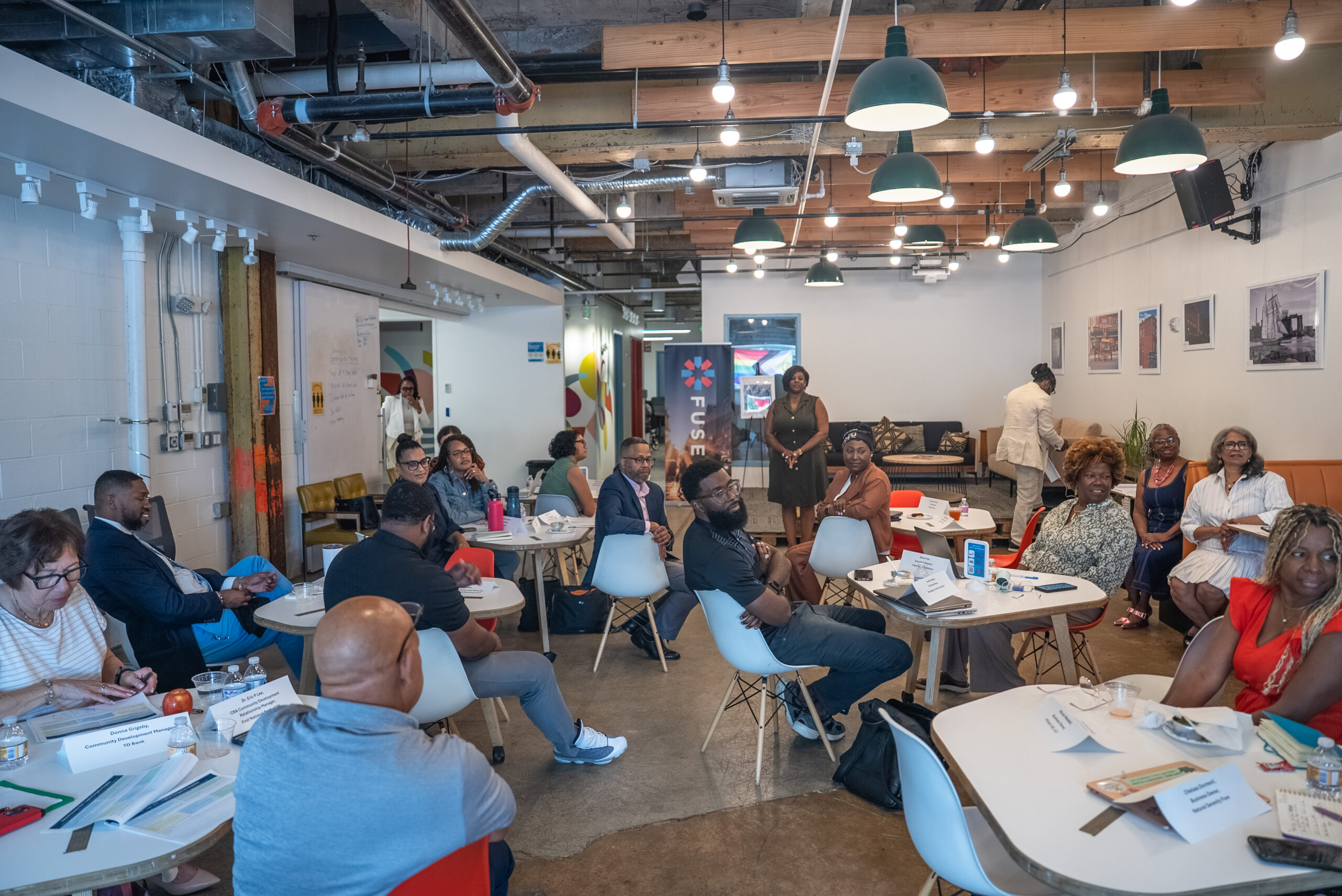
On August 13, 2026, the Innovation Lab brought together Baltimore business owners, four Pillar Leads with expertise across the framework, business-resource organizations, financial institutions, City leadership, and facilitators for a half-day working session at Impact Hub Baltimore.
The Lab was intentionally designed with the business owner at the center.
Owners worked from their own goals, challenges, assessment results, and readiness profiles. They identified a priority 12-month objective, the primary barrier to that objective, and the decision, connection, or action they most needed to advance it.
From there, the discussion moved from diagnosis to execution: What is actually constraining this business? What should be addressed first? What can the owner act on directly? Where can outside support add the greatest value? And which resource is best aligned to the need?
That structure created a targeted working session focused on strategic problem-solving, stakeholder alignment, implementation planning, and accountable next steps.
What we learned
Several findings stood out.
- Capital readiness is multidimensional. Financial challenges often intersect with leadership capacity, customer relationships, technology, staffing, operating processes, and other business fundamentals. Understanding those connections creates an opportunity to strengthen the business while addressing its immediate capital needs.
- Sequencing matters. Entrepreneurs benefit from clarity about the highest-priority action, what should follow it, and which resource is appropriate at each stage.
- Coordination matters as much as availability. A referral is more valuable when the receiving organization understands the business need, the reason for the connection, and the expected outcome. More intentional handoffs can strengthen both the business-owner experience and the effectiveness of the support ecosystem.
- Business owners are essential decision-makers in the process. The strongest solutions reflect the owner’s goals, capacity, timing, and readiness to act and are developed in partnership with advisors, institutions, and resource providers.
- The 4 Pillars framework is promising and ready for additional testing and refinement before broader implementation. Several business cases revealed nuances that a numerical score alone could capture only partially. Those findings provide valuable evidence about where the assessment questions, scoring logic, pathway recommendations, and resource handoffs can be strengthened.
The next phase is to test the approach with additional businesses, examine how consistently the recommendations reflect their actual needs, and determine which elements can be standardized and scaled while preserving the judgment and relationship-building that made the Innovation Lab valuable.
Designing for scale and sustainable impact

The Innovation Lab also surfaced an important implementation question: How can we replicate the value of this high-touch coordination at scale?
The Lab worked because participants could interpret business needs in context, apply expertise, build relationships, and make targeted connections. A scalable model can extend those benefits by combining expert judgment and trusted relationships with tools that make coordination more efficient and accessible.
The next phase of the work is therefore focused on refining the assessment, strengthening pathway logic, improving coordinated handoffs, and exploring how technology can support ecosystem navigation, resource matching, referral management, and progress tracking.
The goal is to develop a more integrated and scalable operating model that combines human judgment, trusted relationships, data, and technology-enabled coordination.
Measurement will also be critical. Success measures should include whether businesses complete priority actions, reach appropriate resources more efficiently, improve readiness, strengthen operations, and become more sustainable over time. That allows us to measure both activity and impact.
What I hope remains
One of the most important lessons of my FUSE Fellowship has been to listen before prescribing.
Government, entrepreneurs, financial institutions, and business-support organizations each bring valuable perspectives to the same ecosystem. Systems change becomes possible when those perspectives come together to examine root causes, create shared understanding, and translate that understanding into practical action.
The Innovation Lab successfully moved the work from research and strategy into real-world testing. It generated evidence about what works well, identified opportunities for refinement, produced actionable pathways for participating businesses, and clarified the next phase of implementation.
As my fellowship moves toward its conclusion, I hope to leave Baltimore with a strategic and scalable approach to business development — one that begins with the entrepreneur, evaluates readiness holistically, coordinates resources more intentionally, and creates clearer pathways to sustainable growth.
Business ownership requires courageous decisions every day.
Our opportunity is to make those decisions better informed and to build an ecosystem that helps Baltimore’s entrepreneurs operate with greater resilience, pursue excellence, and build strong, sustainable businesses. The resources already exist.
The next step is connecting them more effectively.


